

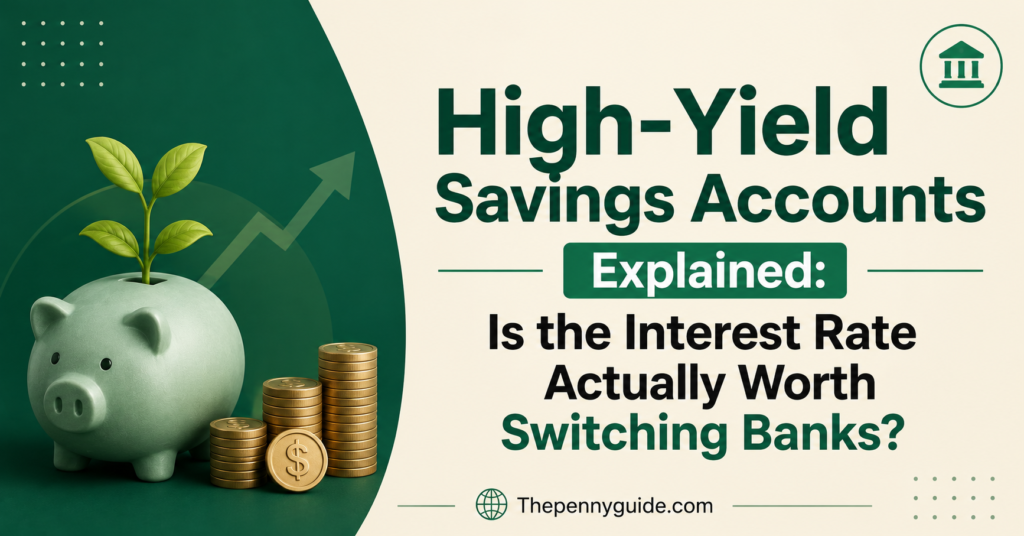
Most people’s savings accounts quietly earn almost nothing. A typical traditional savings account often pays an interest rate so low it barely registers against inflation, meaning money sitting in that account is effectively losing purchasing power over time rather than growing. High-yield savings accounts solve this problem directly, but the natural hesitation is whether the switch is actually worth the hassle, and whether the higher rate is meaningfully different in practice or just a marginal improvement not worth the effort.
This guide breaks down exactly what a high-yield savings account is, how much of a real difference the higher interest rate actually makes, and how to evaluate whether switching makes sense for your specific situation.
What Makes a Savings Account “High-Yield”
A high-yield savings account simply pays a significantly higher annual percentage yield (APY) than a standard savings account offered by most traditional banks. These accounts are most commonly offered by online only or digital banks, which avoid the overhead costs of maintaining physical branches and are able to pass a meaningful portion of that savings on to customers through higher interest rates.
The core product itself functions identically to a traditional savings account, it’s FDIC-insured (when held at an FDIC-member institution), it’s liquid (accessible without penalty, unlike a CD), and it works the same way for deposits and withdrawals. The primary difference is purely the interest rate, though some high-yield accounts also come with lower or no fees compared to traditional bank offerings.
Just How Big Is the Interest Rate Difference?
This is where the real value becomes clear. Traditional savings accounts at major banks frequently offer interest rates that amount to a small fraction of a percent annually, low enough that the actual dollar amount of interest earned on a typical balance is nearly negligible. High-yield savings accounts, by contrast, often offer rates many times higher, sometimes substantially so, depending on current market conditions.
A simplified example: Consider $10,000 sitting in a savings account for one year.
- At a low traditional savings rate, that balance might earn only a small handful of dollars in interest over the entire year
- At a significantly higher high-yield rate, that same balance could earn many times more in interest over the same period, with zero additional effort or risk involved
The exact numbers shift based on current rates, which change over time based on broader economic conditions but the relative gap between traditional and high-yield accounts tends to remain substantial regardless of the specific rate environment.
Is a High-Yield Savings Account Actually Safe?
This is one of the most common hesitations, and it’s a reasonable one to address directly. As long as the account is held at an FDIC-insured institution (or NCUA-insured, for credit unions), your deposits are protected up to the standard federal insurance limits the same protection a traditional bank account carry. Many high-yield savings accounts are offered by digital banks that partner with FDIC-insured institutions behind the scenes, meaning the safety profile is essentially identical to a traditional account, despite not having physical branches.
Before opening any high-yield savings account, it’s worth directly confirming:
- That the institution is FDIC-insured (or NCUA-insured for credit unions)
- Which specific bank actually holds the deposits, if the provider is a fintech company rather than a bank itself
- Current coverage limits, to ensure your full balance is protected if it approaches or exceeds standard insurance thresholds
What to Compare Beyond Just the Interest Rate
While the APY is the headline feature, a few other factors meaningfully affect whether a specific high-yield account is actually the right fit:
- Minimum balance requirements: some accounts require a minimum balance to earn the advertised rate, or to avoid a monthly fee entirely
- Withdrawal limits: federal regulations previously limited certain types of withdrawals from savings accounts; while this specific rule has loosened, some banks still impose their own limits worth checking
- Fee structure: even high-yield accounts occasionally carry fees under specific circumstances, so it’s worth reviewing the full fee schedule rather than assuming a high rate means no fees anywhere
- Ease of transfers: since most high-yield accounts are at separate, often online-only banks, check how quickly and easily you can transfer money to and from your primary checking account when needed
- Rate stability and structure: some accounts offer a promotional rate for a limited introductory period before dropping to a lower ongoing rate, which is worth understanding upfront rather than discovering later
Who Benefits Most From Switching
High-yield savings accounts deliver the most value for money that’s sitting for a meaningful period without being actively spent situations like:
- Emergency funds: money set aside for unexpected expenses that isn’t earning anything meaningful in a low-rate account
- Dedicated savings goals: a house down payment, a wedding, a large upcoming purchase where the timeline is long enough for the higher interest rate to meaningfully compound
- General savings beyond your checking account buffer: any balance kept separate from day-to-day spending money benefits from earning a competitive rate rather than sitting idle
Money you need immediate, frequent access to for daily spending is generally better kept in a standard checking account, since high-yield savings accounts while liquid aren’t typically designed for frequent transaction-level use the way checking accounts are.
Is Switching Actually Worth the Hassle?
For most people, the actual process of opening a high-yield savings account is straightforward often entirely online, taking a matter of minutes, with an initial transfer to fund the account. Given that the interest rate difference compounds continuously with zero ongoing effort required after setup, the one-time hassle of switching is generally outweighed by the sustained value of a meaningfully higher rate, particularly for larger balances or longer time horizons.
A useful way to think about it: the “hassle” of switching is a one-time cost, while the benefit of a higher interest rate compounds every single day the money sits in the account. For anyone keeping a meaningful savings balance in a low-rate traditional account, the math strongly favors making the switch.
A Practical Approach: Start Without Fully Committing
If you’re hesitant to fully switch your primary savings relationship, a low-risk approach is opening a high-yield account specifically for a dedicated goal, an emergency fund or a specific savings target while keeping your existing checking account and banking relationship exactly as it is. This lets you capture the interest rate benefit for money that isn’t actively needed day-to-day, without requiring a full banking overhaul.
Final Thoughts
The gap between a traditional savings account’s interest rate and a high-yield account’s rate is often large enough to represent genuinely meaningful money over time, particularly for larger balances or money set aside for a longer-term goal. Given that the switching process is generally simple and the safety profile is comparable when the account is properly FDIC-insured, the interest rate difference is, for most people, well worth the modest one-time effort required to make the move.