

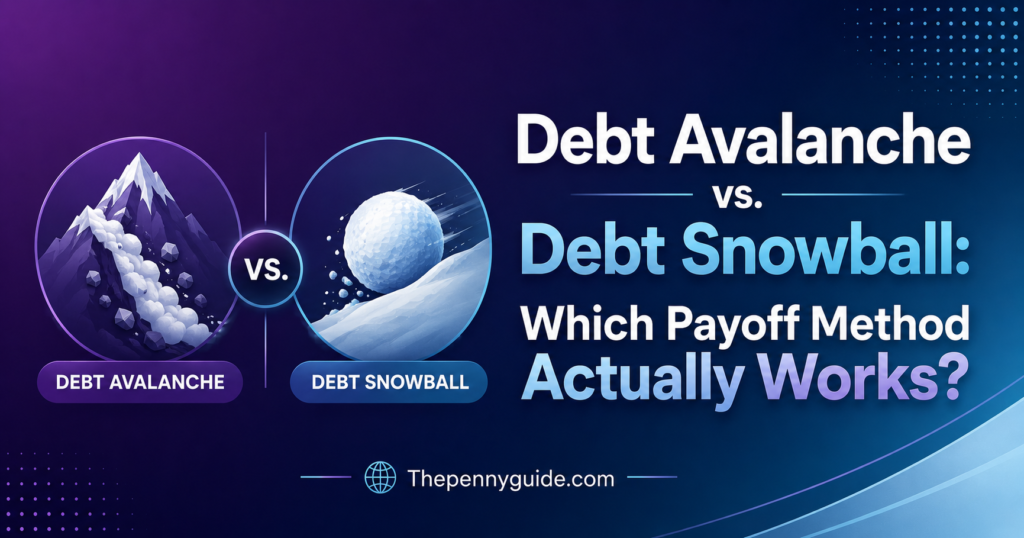
Once you’ve committed to paying off debt, the next question is almost always the same: which order should you tackle it in? Two strategies dominate the conversation the debt avalanche and the debt snowball and both have passionate advocates. The truth is that neither method is universally “correct.” Each is built around a different driving force, one mathematical and one psychological, and the right choice depends heavily on what actually keeps you consistent over the months (or years) it takes to become debt-free.
This guide breaks down exactly how each method works, the real math behind them, and how to figure out which approach or which modified version of one fit how you actually operate.
The Debt Avalanche Method
How it works: List all your debts and order them by interest rate, from highest to lowest. Pay the minimum on every debt except the one with the highest interest rate and put every extra dollar you can toward that highest-interest debt until it’s paid off. Then move to the next-highest interest rate debt and repeat until you’re debt-free.
The logic behind it: High-interest debt costs you the most money over time, regardless of the balance. By eliminating the most expensive debt first, you minimize the total interest paid across your entire payoff journey making the avalanche method mathematically the fastest and cheapest way to become debt-free, assuming consistent payments.
Example: Suppose you have a credit card at 24% interest, a personal loan at 12% interest, and a car loan at 6% interest. Under the avalanche method, you’d direct all extra payments toward the credit card first, since it’s costing you the most in interest, before moving to the personal loan and finally the car loan.
The Debt Snowball Method
How it works: List all your debts and order them by balance, from smallest to largest regardless of interest rate. Pay the minimum on every debt except the smallest one and put every extra dollar toward that smallest balance until it’s fully paid off. Then move to the next-smallest balance, and repeat.
The logic behind it: The snowball method is built around psychological momentum rather than pure math. Paying off a full debt even a small one produces a tangible sense of progress and accomplishment that keeps many people motivated to continue, compared to slowly chipping away at a large, high-interest balance that might take a long time to show visible progress.
Example: Using the same three debts from above a credit card, a personal loan, and a car loan but now ordered by balance instead of interest rate, you’d pay off whichever has the smallest total balance first, even if it’s not the one costing you the most in interest.
The Math: Why Avalanche Technically Saves More Money
From a pure numbers standpoint, the debt avalanche method will almost always save more in total interest paid and often results in becoming debt-free slightly faster, because you’re eliminating your most expensive debt first rather than letting it continue accruing interest while you focus elsewhere.
The size of that difference depends heavily on how spread out your interest rates are. If your debts carry similar interest rates, the avalanche and snowball methods produce nearly identical results. If you’re carrying a mix of high-interest credit card debt alongside lower-interest loans, the avalanche method’s advantage becomes considerably more significant.
The Psychology: Why Snowball Often Wins in Practice
Despite the avalanche method’s mathematical edge, research and real-world observation consistently show that many people are more likely to stick with the snowball method to completion. Paying off debt is often as much a behavioral challenge as a financial one and the snowball method’s early wins provide a sense of tangible progress that helps sustain motivation over what can be a long, sometimes discouraging process.
This matters more than it might initially seem. A mathematically optimal strategy that someone abandons after six months due to lost motivation ultimately costs more than a “less efficient” strategy that someone actually completes. The best payoff method, in practice, is the one you’ll actually stick with consistently until your debt is gone.
A Side-by-Side Comparison
| Factor | Debt Avalanche | Debt Snowball |
|---|---|---|
| Debt payoff order | Highest interest rate first | smallest balance first |
| Total interest paid | Generally lowest | Generally higher |
| Time to debt-free | Often slightly faster | Often slightly slower |
| Motivation structure | Delayed gratification | Early, frequent wins |
| Best suited for | Highly disciplined, numbers-focused individuals | Those who benefit from visible, frequent progress |
How to Decide Which Method Fits You
A few honest questions can help clarify which approach is the better fit:
- Have you started and abandoned a debt payoff plan before? If motivation has historically been the obstacle rather than understanding the math, the snowball method’s early wins may serve you better than a mathematically optimal but slower-feeling plan.
- How spread out are your interest rates? If you’re carrying high-interest credit card debt alongside low-interest loans, the avalanche method’s savings become more meaningful and worth prioritizing.
- Do you find satisfaction in numbers and long-term optimization, or in visible, frequent progress? Neither preference is wrong but being honest about which one actually keeps you consistent matters more than choosing whichever method sounds more responsible.
A Hybrid Approach: Taking the Best of Both
Some people use a modified strategy that blends both methods for example, starting with the snowball method to build early momentum with one or two small wins, then transitioning to the avalanche method once the habit of consistent extra payments feels established. This isn’t a formally named strategy, but it’s a legitimate, practical approach for people who want early motivation without fully sacrificing the interest savings of prioritizing high-rate debt.
Another common variation: if one debt carries a dramatically higher interest rate than the rest (a high-APR credit card, for example), some people prioritize that single debt first regardless of balance, then switch to a snowball approach for the remaining, lower-interest debts. This captures much of the avalanche method’s interest savings on the most expensive debt while still allowing for the motivational benefit of the snowball approach afterward.
What Matters More Than the Method Itself
Regardless of which approach you choose, a few underlying habits matter more than the specific payoff order:
- Consistently paying more than the minimum on your target debt, even if it’s a modest extra amount
- Avoiding new debt while working through an existing payoff plan, which can otherwise offset your progress
- Tracking progress visibly, whether through a spreadsheet, app, or simple written list, to reinforce momentum regardless of which method you’re using
- Building a small emergency buffer alongside your debt payoff plan, so an unexpected expense doesn’t force you back into debt mid-plan
Final Thoughts
The debt avalanche method wins on pure math, and the debt snowball method often wins on real-world consistency. Neither is universally correct the better method is whichever one you’ll actually follow through on until your debt is fully paid off. Understanding both approaches honestly, rather than assuming one is automatically superior, is the clearest path to choosing a strategy that actually gets you to debt-free, not just one that looks good on paper.